
Classification of Liferaft Structural Forms and Related Knowledge Introduction
Release time:
2024-12-04
Author:
Source:
Abstract
The liferaft is a type of lifesaving equipment used by crew members when a ship is in distress. It can be quickly deployed onto the water surface and floats above the water for crew members to board. Various liferafts have a certain buoyancy, a canopy to shield from wind, rain, and cold, as well as food and fresh water for survivors and necessary equipment. Its characteristics include small size, light weight, and simple and convenient operation. Its main disadvantages are: no self-propulsion capability, can only float in the water waiting for rescue, easy to capsize after deployment and requires manual adjustment, and the buoyancy tubes are prone to damage and leakage.
Classification of liferaft structural forms
(1) Rigid liferaft
The buoyancy of a rigid liferaft should be provided by approved natural buoyancy materials. These buoyancy materials should be placed near the periphery of the liferaft. The buoyancy materials are flame-retardant or protected by flame-retardant coverings, and the bottom of the raft can prevent seawater from entering and effectively support occupants above the water surface while providing warmth. The liferaft can right itself or be righted by a person when capsized.
(2) Inflatable liferaft
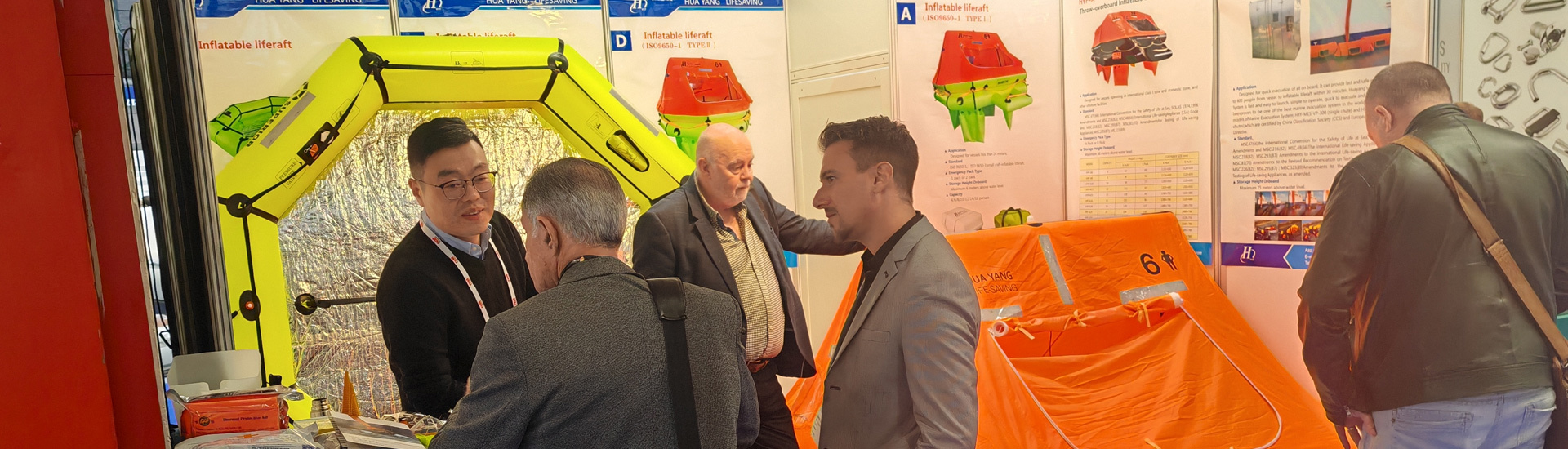
It is made of materials such as rubber and nylon fabric, inflated with gas to form a round or oval small raft with a canopy. Depending on the deployment method, it is generally divided into throw-over type and mechanical drop type.
1. Throw-over liferaft - When a ship is in distress, the raft can be thrown into the sea by human power or by its own weight, and in a very short time, the inflation rope pulls the valve of the gas cylinder to inflate and shape it.
2. Mechanical drop type - Mainly used for passenger ships, scientific research vessels, and training ships. The raft is first taken out from the storage compartment or deck storage, suspended on the liferaft hoist, and the inflation pull rope is pulled to inflate and shape it at the ship's side. Then, a platform made of rubber is secured for crew members and passengers to board the liferaft from the deck, and the raft is then lowered to the water surface. This allows occupants to avoid difficulties such as climbing a rope ladder or jumping into the water.
Structure of the liferaft
1. The structure of each liferaft should be able to withstand exposure and floating for 30 days under all sea conditions.
2. After being dropped into the water from a height of 18m, the liferaft and its accessories should be usable.
3. In both the raised and unraised conditions of the canopy, the floating liferaft should be able to withstand repeated jumping from a height of at least 4.5m above the bottom of the raft.
4. The structure of the liferaft and its fittings should allow the liferaft, when fully loaded with all occupants and equipment and with one sea anchor deployed, to be towed at a speed of 3 knots in calm water.
5. The liferaft should have a protective canopy to shield occupants from exposure, which can automatically raise when the liferaft descends and reaches the water surface. The internal color should not cause discomfort to occupants, and liferafts accommodating more than 8 people should have at least two symmetrical entrances. When these entrances are closed, the canopy should allow sufficient air for the occupants; there should be at least one observation window on the canopy, and there should also be a device for collecting rainwater.
Fittings of the liferaft
1. Securely install chain ring handles along the outer and inner sides of the liferaft.
2. Provide a bow line, which should be at least 10m long plus the distance from storage to the lightest load waterline or 15m (whichever is greater).
3. An artificial control light should be installed on the canopy of the liferaft. The light should be white and capable of continuous operation for 12 hours. The interior of the liferaft should be equipped with at least one artificial control light that can operate continuously for 12 hours. When the canopy is raised, the light should automatically turn on and provide sufficient brightness for occupants to read the survival and equipment instructions. The battery type should not deteriorate due to moisture or humidity in the storage location.
Recommend Reading
2025-02-07
Classification, Storage, and Maintenance of Lifeboats
2024-12-04
2024-12-04